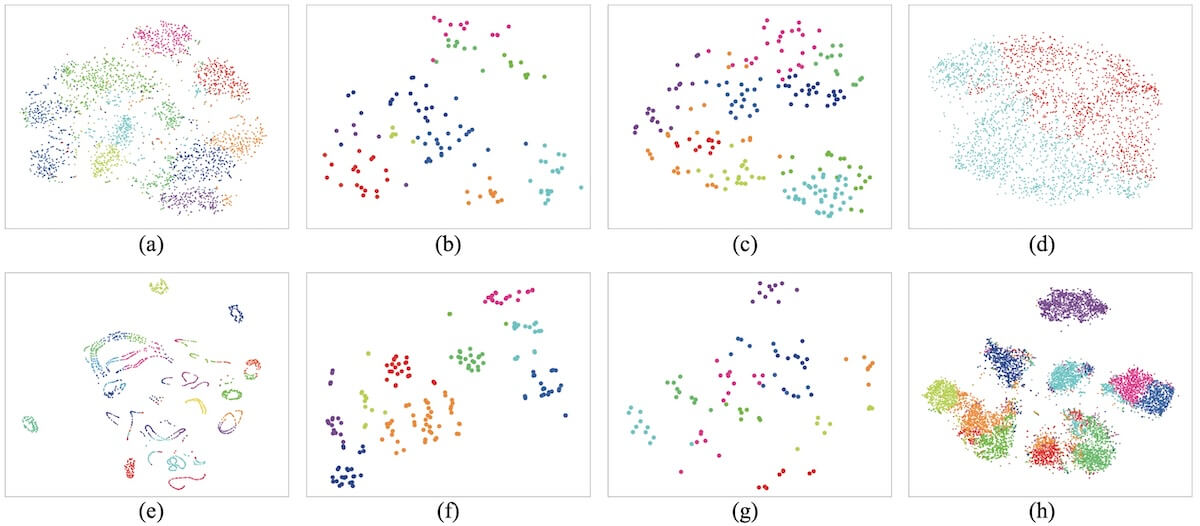
[1]. A. Yuan, M. You, D. He and X. Li, "Convex Non-Negative Matrix Factorization With Adaptive Graph for Unsupervised Feature Selection," in IEEE Transactions on Cybernetics, vol. 52, no. 6, pp. 5522-5534, 2022.
An intuitive, block-based modular computer vision learning platform. Build processing pipelines on the web like puzzles (e.g., image processing, face detection, object tracking) to automatically generate and execute the corresponding Python (OpenCV/MediaPipe) code.
Lesson 1: Affordance and Mapping — Hands-on Experiment
Experience the concepts of affordance and mapping through an interactive light-bulb-and-switch interface. Compare bad mapping vs. good mapping and learn why intuitive control design matters. Includes an electric maze demo.
Verify Fitts's Law by clicking on-screen targets of varying sizes and distances. After the experiment, analyze and visualize the collected data to confirm whether Fitts's Law holds.
Lesson 3: Hick's Law — Choice Reaction Time Experiment
A game-style experiment where you select randomly displayed words on screen. Measures how the number of choices affects reaction time, demonstrating Hick's Law (decision time increases logarithmically with the number of options).
An intentionally poorly designed user interface violating Fitts's Law and Hick's Law to increase cognitive load, used for UI audit exercises in lectures.
An interactive notebook with paired "bad example" and "good example" code cells for each of Nielsen's 10 usability heuristics. Compare real UI implementations side by side to learn the fundamentals of usability evaluation.